Sewzy
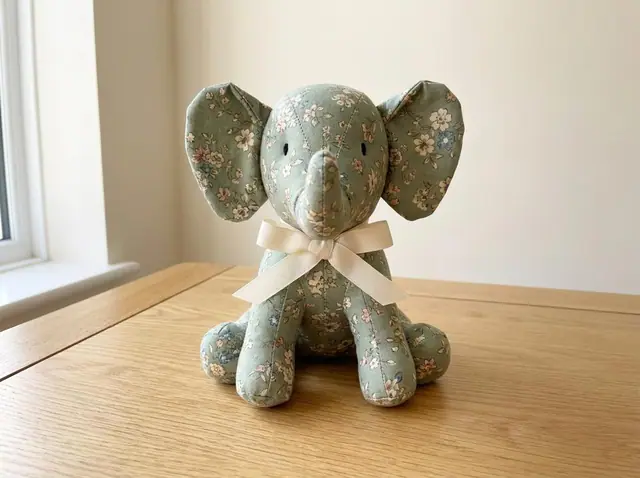
A memory elephant is a stuffed elephant sewn from clothing that belonged to someone, such as a baby onesie, a dad's shirt or a favorite blanket. The Memory Elephant pattern in the Sewzy app comes in 10 sizes from 6 to 24 inches, is rated intermediate and lists about 240 minutes. What makes it different from the other memory animals is the trunk, the big ears that fan out sideways and a simple frayed tail.
TL;DR
- The Memory Elephant is in the Sewzy app. It is not one of the free patterns.
- 10 sizes, 6 to 24 inches finished height. A baby onesie makes the 6 or 8 inch elephant.
- Seam allowance is ¼ inch (6 mm), included in the pieces.
- Elephant details: a trunk sewn into the head sides, two big flat ears with a contrast inner ear, and a frayed fabric tail.
- A pipe cleaner curls the trunk. It is essential in the 6 and 8 inch sizes. See the safety notes below if the elephant is for a baby.
Sew the Memory Elephant from this guide, step by step, in the Sewzy app
Pick your size, print it from your phone, and follow every step with a sewing coach beside you.


Why choose an elephant for a memory animal?
Elephants stand for memory, which makes this a thoughtful choice for a keepsake from a loved one's clothes. It also suits a baby shower or a first Christmas, because the shape reads clearly in any print, from a plaid shirt to a floral dress. For the general method of choosing and preparing clothes, read how to make memory bears from clothing. This guide covers what is different about the elephant. If you prefer another animal, see the memory bunny, memory cat or memory dog guides.
How big is a memory elephant, and how much fabric does it need?
Sizes are the finished height. Here is what each size is made from and the fabric it needs.
| Finished height | Made from | Fabric |
|---|---|---|
| 6 inches | Baby onesie or sleeve | ⅛ yard |
| 8 inches | Baby onesie | ⅛ yard |
| 10 inches | Child tee | ¼ yard |
| 12 inches | Adult tee or shirt | ⅓ yard |
| 14 inches | Adult shirt | ½ yard |
| 16 inches | Adult shirt | ½ yard |
| 18 inches | Adult shirt or blouse | ⅔ yard |
| 20 inches | 2 shirts or a dress | ¾ yard |
| 22 inches | 2 shirts or a dress | 1 yard |
| 24 inches | Flannel or a blanket | 1¼ yards |
For a first elephant, the 12 inch size from one adult shirt is a good choice. The trunk is easier to turn and stuff at that size. The 6 and 8 inch sizes fit a onesie but take patience.
What do I need besides fabric?
- Eyes: safety eyes (6 mm for the 6 to 10 inch sizes, 9 to 12 mm above), or embroidered eyes.
- Trunk: a pipe cleaner to curl it (essential in the 6 and 8 inch sizes).
- Stuffing: polyester fiberfill, plus optional poly pellets for a floppy elephant.
- Joints (optional): 4 plastic doll joints, or 4 shank buttons with strong thread.
- Contrast fabric: a second garment for the foot pads and inner ears, such as a shirt cuff or a floral scrap.
- Tools: a doll needle and ladder-stitch thread, plus a chopstick for turning the trunk.
- Interfacing: lightweight woven interfacing for anything stretchy. See what is interfacing if it is new to you.
How do I sew a memory elephant, step by step?
The pattern has seven steps. Here they are in plain words.
- Prepare the garment. Wash and press it, then cut it open along the seams into flat panels. Fuse lightweight woven interfacing to knits, jersey and thin cottons so they do not stretch. Decide where a pocket, buttons or a logo will land. The tummy (body front) and the foot pads are the favorite spots.
- Cut. Print only your size. Cut 2 head sides (mirrored), 1 head gusset, 2 body fronts, 2 body backs, 4 arms and 4 legs (two mirrored pairs each), 2 foot pads, 4 ears (2 outer and 2 inner) and 1 tail. Copy every notch, the joint dots, the eye marks and the gap and opening lines.
- Head. Put the head sides right sides together. Stitch from the bridge notch down the front of the trunk, around the trunk tip and up the back of the trunk to the chin and neck. Pin the gusset between the two sides from the bridge notch over the crown to the nape, matching the side notches, and stitch both sides. Clip the curves, turn, and push the trunk out with a chopstick.
- Face and ears. Fit the safety eyes at the eye marks, or embroider them later. For each ear, sew one outer and one inner piece right sides together and turn it flat. Do not stuff it. Fold a small pleat at the base and ladder-stitch each ear between its notches so it fans out sideways. Stuff the trunk first, sliding in a pipe cleaner to curl it, then stuff the head firmly. Run a gathering thread around the neck edge, pull it up and knot it.
- Body. Stitch the body fronts together at the center front. Stitch the body backs at the center back, leaving the marked opening. Open them out, place front on back right sides together, stitch all around from neck to neck and turn through the opening.
- Arms and legs. Sew each pair right sides together, leaving the gap open. On the legs, sew the foot pad into the bottom between the notches before turning. Turn, stuff and close the gaps with ladder stitch, or leave the tops open if you use plastic doll joints.
- Join and finish. Stuff the body and close the opening. Ladder-stitch the gathered head to the neck opening. Attach the limbs at the joint dots with plastic doll joints, shank buttons and strong thread, or simply ladder-stitch them on. For the tail, fold the strip in half lengthwise, stitch, turn, fray ½ inch at the end and stitch it to the back seam.
If hand closing is new to you, how to sew a ladder stitch shows the stitch.
How do I get the trunk and ears right?
Trunk. The trunk is part of the head sides, so the first seam shapes it. Sew slowly around the tip and clip the curves before turning. Push it out with a chopstick, then stuff it first, in small pinches, before you stuff the rest of the head. The pipe cleaner goes in with the stuffing and lets you bend the trunk into a gentle curl. Fold both ends of the pipe cleaner back on themselves so no wire tip can poke through the fabric.
Ears. Elephant ears are big and flat. They are turned but never stuffed. The small pleat at the base and the placement between the notches make them fan out sideways. A contrast inner ear, like a shirt cuff or a floral scrap, shows off well because the ears are so large.
Is a memory elephant safe for a baby?
The pattern says to embroider the eyes and skip the pellets for a baby. We also suggest skipping the safety eyes, plastic joints and shank buttons, ladder-stitching the limbs on instead, and leaving off any ribbon around the neck. The pipe cleaner is a wire, so for a toy a baby will hold, choose a size of 10 inches or more and stuff the trunk firmly without it. A 6 or 8 inch elephant with a pipe cleaner is best kept as a keepsake on a shelf.
Common mistakes
- Skipping interfacing on knits. Jersey stretches under the needle and the trunk twists.
- Stuffing the head before the trunk. You cannot reach the tip after. Trunk first, always.
- Stuffing the ears. They are meant to stay flat and floppy.
- Cutting before planning. Decide where the pocket, logo or buttons will sit first.
- Bare wire ends. Fold the pipe cleaner tips back so they cannot work through the fabric.
How do I care for it, and what can I add?
Spot clean it, or hand wash cold if all the fabrics are washable, and air dry. Write the person's name and dates on twill tape and stitch it into the back seam, or tuck a note into a shirt pocket on the tummy. A 6 inch mini elephant from the offcuts makes a keychain, but keep it away from babies and toddlers because of the pipe cleaner. Planning a gift? See baby shower gifts to sew or baby's first Christmas gifts to sew, and browse every keepsake animal, including the Memory Bear and Memory Bunny, in the memory animal patterns collection.
 How to sew butterfly wings: quilted, 3 sizes, 1 hour7 min read
 How to sew fleece on a regular sewing machine7 min read
 Baby's first Christmas gifts to sew: 7 handmade ideas7 min read